




 English
 Español
 Français


Concrete pours are only as good as the consolidation. Air pockets weaken concrete. Honeycombing ruins the surface. A lithium battery cement concrete vibrator eliminates those problems. The high-frequency vibration fluidizes the concrete, allowing air bubbles to escape and aggregate to settle into a dense matrix. The lithium battery powers the vibrator without cords or generators. Lithium battery cement concrete vibrator manufacturers build these tools for construction sites where mobility and reliable consolidation matter.
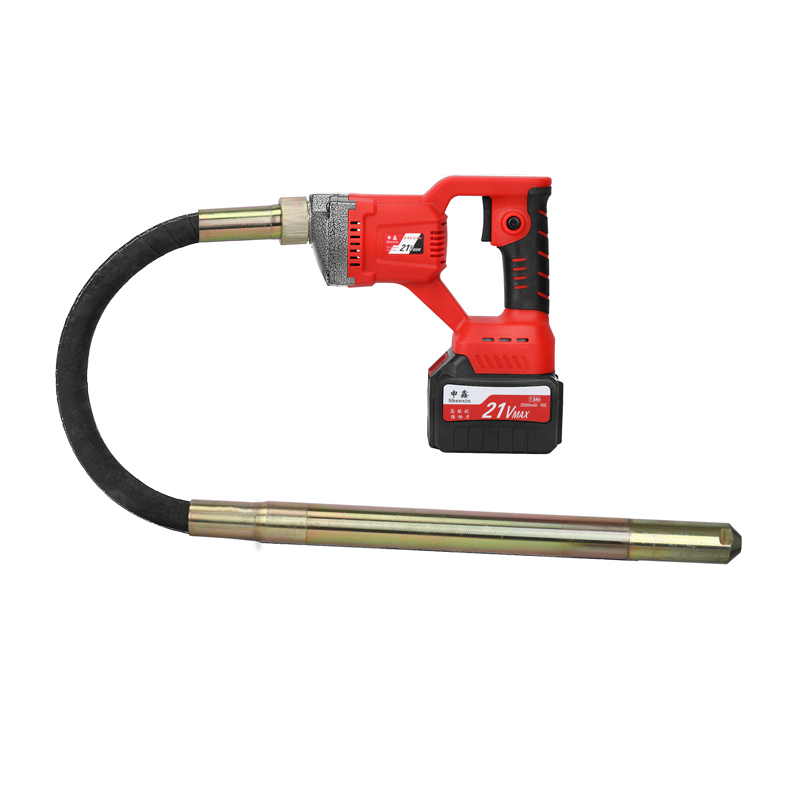
The Vibration Action Consolidates the Concrete
High-frequency vibration reduces concrete viscosity
Fresh concrete has internal friction that traps air and prevents compaction. A lithium battery cement concrete vibrator generates high-frequency oscillations that temporarily fluidize the concrete. The material flows, air bubbles rise, and the concrete compacts around reinforcement. The vibration does the work that would take hours of manual rodding.
The vibrating head is inserted directly into the concrete
The vibrator head is immersed in the wet concrete. A lithium battery cement concrete vibrator manufacturer designs the head to reach deep into the pour. The vibration radiates outward from the head, consolidating a zone around it. The operator systematically moves the head through the pour, ensuring full compaction.
The vibration causes aggregate to settle into a dense arrangement
Aggregate particles rearrange themselves under vibration. A lithium battery cement concrete vibrator causes the aggregate to settle into the densest possible configuration. Voids are filled, density increases, and the concrete achieves its design strength.
Common specs for lithium battery cement concrete vibrators:
- Vibration frequency: 8,000 to 12,000 RPM
- Battery voltage: 18V to 36V
- Vibrator head diameter: 25mm to 60mm
- Head length: 300mm to 600mm
- Shaft length: 1m to 3m
- Weight: 4kg to 8kg
- Power source: lithium battery
The Motor and Drive System Generate the Vibration
The motor spins an eccentric weight to create the vibration
Inside the vibrator head, a motor spins an eccentric weight at high speed. A lithium battery cement concrete vibrator manufacturer designs the weight and motor to produce the right frequency and amplitude for concrete consolidation. The imbalance creates the vibration that fluidizes the concrete.
The flexible shaft transmits power to the head
The motor is in the handle or a separate unit, and the vibration is delivered through a flexible shaft. A lithium battery cement concrete vibrator manufacturer uses a shaft that bends around obstacles and reaches deep into the form.
The lithium battery provides cordless power
Construction sites often lack power outlets near concrete pours. A lithium battery cement concrete vibrator runs on rechargeable batteries, so the operator can work anywhere on the site. No generator, no extension cords.
The Battery System Keeps the Vibrator Running
Lithium-ion batteries deliver consistent power until they're empty
Older battery types lose power as they drain. A lithium battery cement concrete vibrator uses lithium-ion batteries that maintain constant vibration frequency until the battery is nearly depleted. The concrete gets consistent consolidation from start to finish.
The battery is portable and quick to change
The vibrator stops when the battery dies. A lithium battery cement concrete vibrator manufacturer uses swappable battery packs that slide on and off in seconds. The operator keeps working while a spare battery charges.
The battery system is shared across tools
Many job sites use multiple battery-powered tools. A lithium battery cement concrete vibrator uses the same battery system as drills and other construction tools. The same batteries power multiple tools.
Where Cordless Concrete Vibrators Are Used
Building and foundation construction
Slabs, footings, columns, and walls need proper consolidation. A lithium battery cement concrete vibrator is used in residential and commercial construction where power access is limited.
Bridge and infrastructure projects
Heavy concrete sections demand thorough compaction. A lithium battery cement concrete vibrator reaches deep sections and handles the demands of infrastructure work.
Precast concrete manufacturing
Precast elements require consistent quality. A lithium battery cement concrete vibrator is used in casting beds and moulds to compact concrete uniformly. The product is defect-free.
Residential and commercial slab construction
Flatwork requires consolidation near edges and penetrations. A lithium battery cement concrete vibrator compacts concrete around utilities and edges. The slab is durable and the surface is smooth.
The Points That Separate a Good Vibrator from a Bad One
Vibration frequency has to match the mix design
Different concrete mixes require different frequencies. A lithium battery cement concrete vibrator manufacturer should offer vibrators with adequate frequency for the application.
The head diameter has to fit the reinforcement spacing
Tight reinforcement requires a smaller head. A lithium battery cement concrete vibrator manufacturer should offer different head sizes.
The battery runtime has to cover the pour duration
If the battery dies mid-pour, you've got a problem. A lithium battery cement concrete vibrator manufacturer should specify the runtime for the battery.
The shaft has to be durable and flexible
Bending and twisting take their toll. A lithium battery cement concrete vibrator manufacturer should use shafts that can handle repeated use.
A lithium battery cement concrete vibrator is a tool that makes concrete pours stronger and more reliable. The vibration consolidates the concrete, the lithium battery provides cordless power, and the compact design fits tight spaces. Lithium battery cement concrete vibrator manufacturers build these tools for construction sites. That's what makes them essential. That's what makes them the new standard for concrete consolidation.
